Every bottle of water that leaves our factory has already passed through a carefully controlled industrial journey.
Long before a sealed bottle reaches a supermarket shelf, water has been tested, treated, filtered, monitored, filled, sealed, inspected, packed and tracked through one of the most tightly controlled manufacturing environments in the beverage industry.
Inside our mega-scale facility, the operation never really feels like a simple bottling plant. It is a combination of water-treatment technology, automated manufacturing, laboratory science and high-speed packaging—all working as one continuous system.
So, what actually happens between the moment raw water enters our facility and the moment a finished bottle is loaded onto a truck?
Let’s walk through the entire process.
1. It Starts With the Water Source
We don’t begin with a bottle.
We begin with the water.
Before a single drop enters production, our technical and quality teams need to understand exactly what is coming from the approved source. Water chemistry can vary naturally, so we analyze the incoming water before determining how it should move through the treatment system.
The raw-water laboratory checks parameters such as turbidity, pH, dissolved solids, hardness, mineral composition and microbiological quality, along with other parameters required by our specifications and applicable regulations.
This analysis determines how the treatment system is operated.
For us, consistency starts before treatment even begins.
2. Raw Water Enters the Plant
Once the source water meets the required acceptance criteria, it is transferred into controlled raw-water storage.
From here, pumps and automated controls move the water into the treatment section.
This is where the plant begins transforming source water into product water.
And at our scale, this isn’t happening one tank at a time.
It is a continuous industrial operation, with instrumentation monitoring flow, pressure, temperature and other critical process parameters across the system.
3. First Line of Defense: Pre-Treatment
The first objective is to protect the more sensitive purification equipment downstream.
Raw water may contain suspended particles, sediment, organic matter and other substances that need to be reduced before advanced treatment.
Depending on the characteristics of the source, the treatment train can include multimedia filtration, activated carbon, cartridge filtration and other appropriate technologies.
Each stage has a specific job.
The idea isn’t simply to “filter the water.”
It is to progressively condition the water so that every downstream system can perform reliably.
4. Advanced Purification
Now the water reaches the heart of the treatment plant.
Where required by the source-water characteristics and final product specification, advanced technologies such as reverse osmosis, ultrafiltration or other membrane processes may be used.
Reverse osmosis, for example, uses a semi-permeable membrane to reduce dissolved salts and a broad range of contaminants.
But here’s something important:
More purification isn’t automatically better.
The treatment system has to be designed around the product we are manufacturing and the standards that product must meet.
Our engineers therefore control the treatment process according to defined specifications rather than simply trying to remove everything from the water.
5. Getting the Mineral Profile Right
Water isn’t just H₂O from a manufacturing perspective.
Its mineral profile affects its characteristics and, depending on the product category, its identity.
At this stage, the process differs according to whether we are producing purified drinking water, mineralized water or another regulated water category.
Where mineral adjustment is part of the product specification, the treated water can be carefully conditioned to achieve the required composition.
Every adjustment is controlled and verified through laboratory analysis.
The goal is simple:
Bottle after bottle should meet the same defined specification.
6. Final Water Protection
Once the water has completed the required treatment stages, it enters the final-water system.
This is where the philosophy of the entire plant becomes especially important.
We don’t want highly treated water exposed unnecessarily to the surrounding environment.
So the system is designed around hygienic piping, controlled tanks, appropriate disinfection technology and minimized exposure.
Depending on the validated process, technologies such as UV and ozone may form part of the microbiological-control strategy.
The water is then ready for the most critical transition of all:
from the treatment plant into the bottle.
7. Meanwhile, We’re Making the Bottles
While one side of the factory is treating water, another side may be producing the containers that will hold it.
For PET packaging, production can begin with preforms.
A preform is heated and transferred into a bottle mold. High-pressure air then expands the material against the mold walls, creating the final bottle shape.
At mega scale, this process is highly automated.
Bottle weight, dimensions, appearance and mechanical performance are controlled so that the containers can move reliably through the high-speed filling line.
8. Bottle Meets Water
This is the moment where the two production streams come together.
Clean bottles enter the filling system.
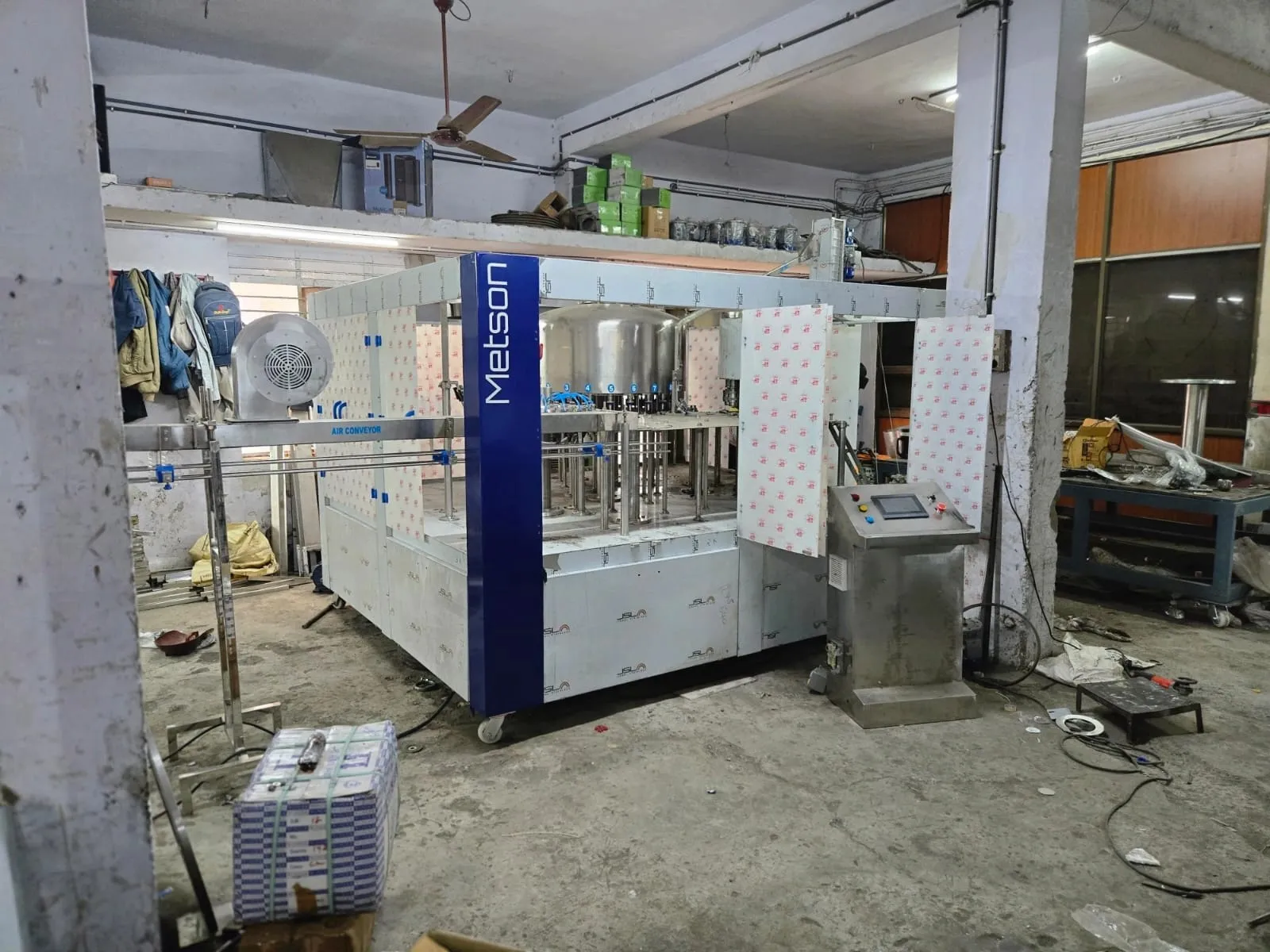
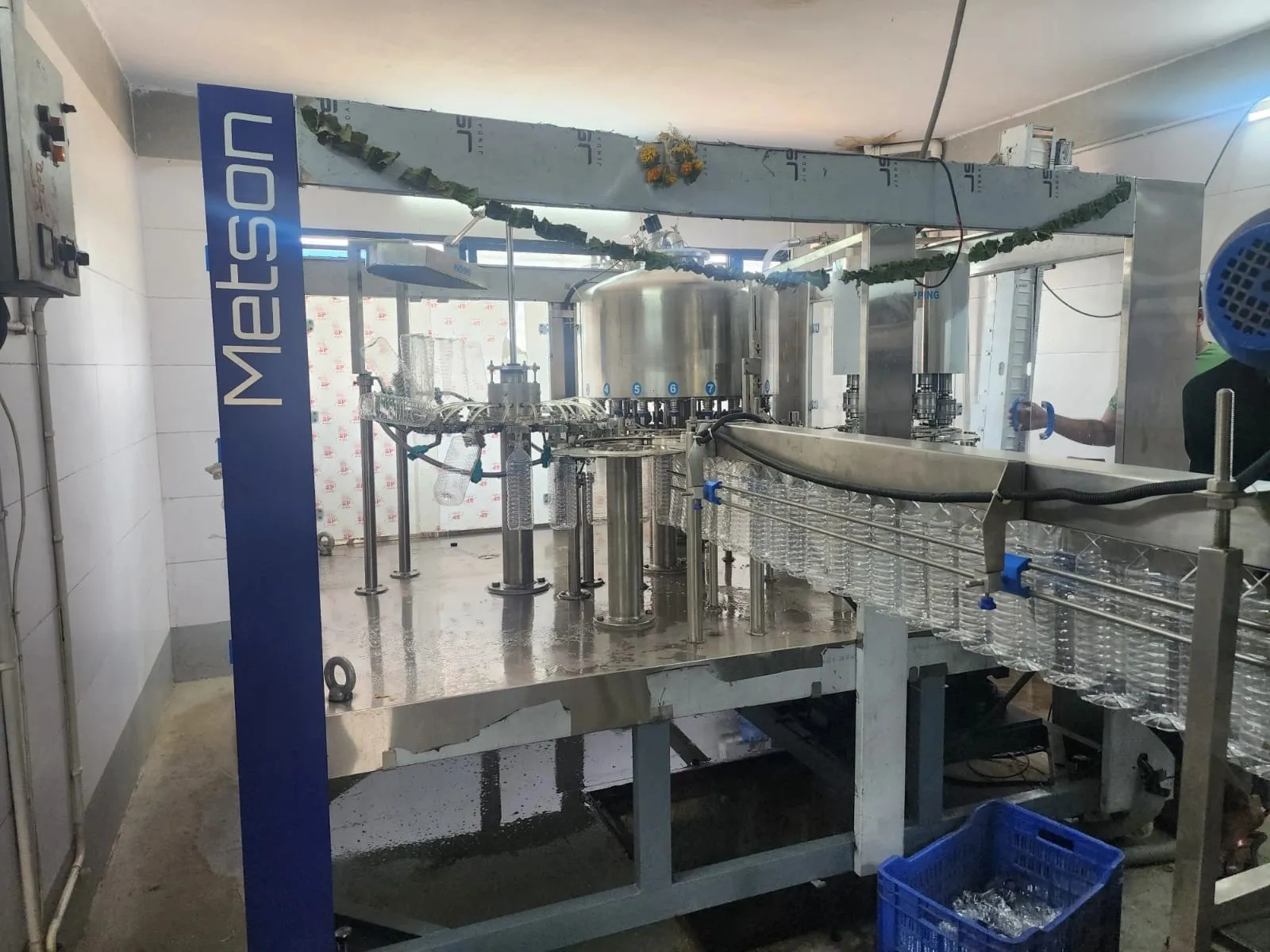
Depending on the equipment configuration, bottles pass through rinsing, filling and capping operations in an integrated high-speed system.
The filling environment is carefully controlled because the quality of the finished product depends not only on the water leaving the treatment plant, but also on what happens during packaging.
The objective is to move from treated water to sealed product with as little opportunity for contamination as possible.
9. Filling Thousands of Bottles
The filling line is where the scale of the operation becomes obvious.
Bottles move continuously through the system.
One station handles filling. Another handles closures. Downstream equipment applies labels, codes the product and inspects the finished package.
There is no room for a “close enough” approach.
Fill volume, cap placement, labeling and coding all have defined requirements, and automated systems continuously monitor the line.
10. Every Bottle Has an Identity
Once the bottle is filled and capped, we need to know where it came from.
That’s where batch coding and traceability come in.
Production information can connect the finished product to a particular batch, production period, line and other manufacturing records.
Traceability is essential because manufacturing isn’t only about producing a product.
It’s about being able to account for that product throughout its entire journey.
11. Automated Inspection
Before the bottles disappear into cartons or shrink-wrapped packs, inspection systems examine them.
Depending on the line, machine-vision and sensor systems can identify problems such as incorrect labels, missing or improperly positioned caps, abnormal fill levels, damaged containers or coding errors.
Products that don’t meet the defined criteria are automatically rejected from the main production flow.
This is one of the biggest differences between modern mega-scale manufacturing and manual bottling:
quality control is built into the production line itself.
12. From Individual Bottles to Transport Packs
A finished bottle isn’t necessarily the final shipping unit.
The bottles are grouped into packs using automated packaging equipment.
Depending on the market and product format, this can involve shrink film, cartons, trays or other approved packaging configurations.
The packaging line has one job: turn thousands of individual bottles into stable, transport-ready units at production speed.
13. Robotic Palletizing
Now the product is ready for the warehouse.
Automated palletizing systems arrange cases or packs into carefully designed pallet patterns.
Robots can repeatedly perform the same movements with remarkable consistency, building stable loads ready for forklifts and distribution vehicles.
At this point, the product has traveled through an entire manufacturing ecosystem:
Source → Treatment → Quality Control → Bottle Production → Filling → Inspection → Packaging → Palletizing
But we’re not finished yet.
14. The Warehouse Is Part of the Process
Finished goods move into controlled warehouse operations where inventory is tracked by product and batch.
The warehouse isn’t simply a place where bottles sit.
It is another part of our traceability and distribution system.
Products are organized for efficient order fulfillment, stock rotation and transportation.
15. Loading the Trucks
Finally, pallets are released for dispatch.
Forklifts move finished products from the warehouse to loading areas, where shipments are prepared for distribution.
The trucks leave the facility carrying something that looks incredibly simple to the customer:
a bottle of water.
But behind that bottle is an entire chain of engineering and control.
The Full Journey
From our perspective, the complete process looks like this:
Approved Water Source
→ Raw-Water Testing
→ Raw-Water Storage
→ Pre-Treatment
→ Advanced Purification
→ Mineral Conditioning Where Applicable
→ Final Disinfection
→ Final-Water Testing
→ Bottle Manufacturing
→ Bottle Inspection
→ Bottle Rinsing
→ High-Speed Filling
→ Capping
→ Labeling
→ Batch Coding
→ Automated Inspection
→ Secondary Packaging
→ Robotic Palletizing
→ Finished-Goods Warehouse
→ Distribution
What Really Makes a Mega Water Plant?
The impressive part isn’t one machine.
It’s the integration of the entire system.
Water treatment has to work with the laboratory. The laboratory has to work with production. Production has to work with packaging. Packaging has to work with warehousing. And every stage has to maintain traceability and hygiene.
That’s what turns a bottling facility into a mega-scale manufacturing operation.
Because when production reaches millions of bottles, consistency cannot depend on individual judgment.
It has to be engineered into the process.
And that is the real story behind every bottle that leaves our plant.
